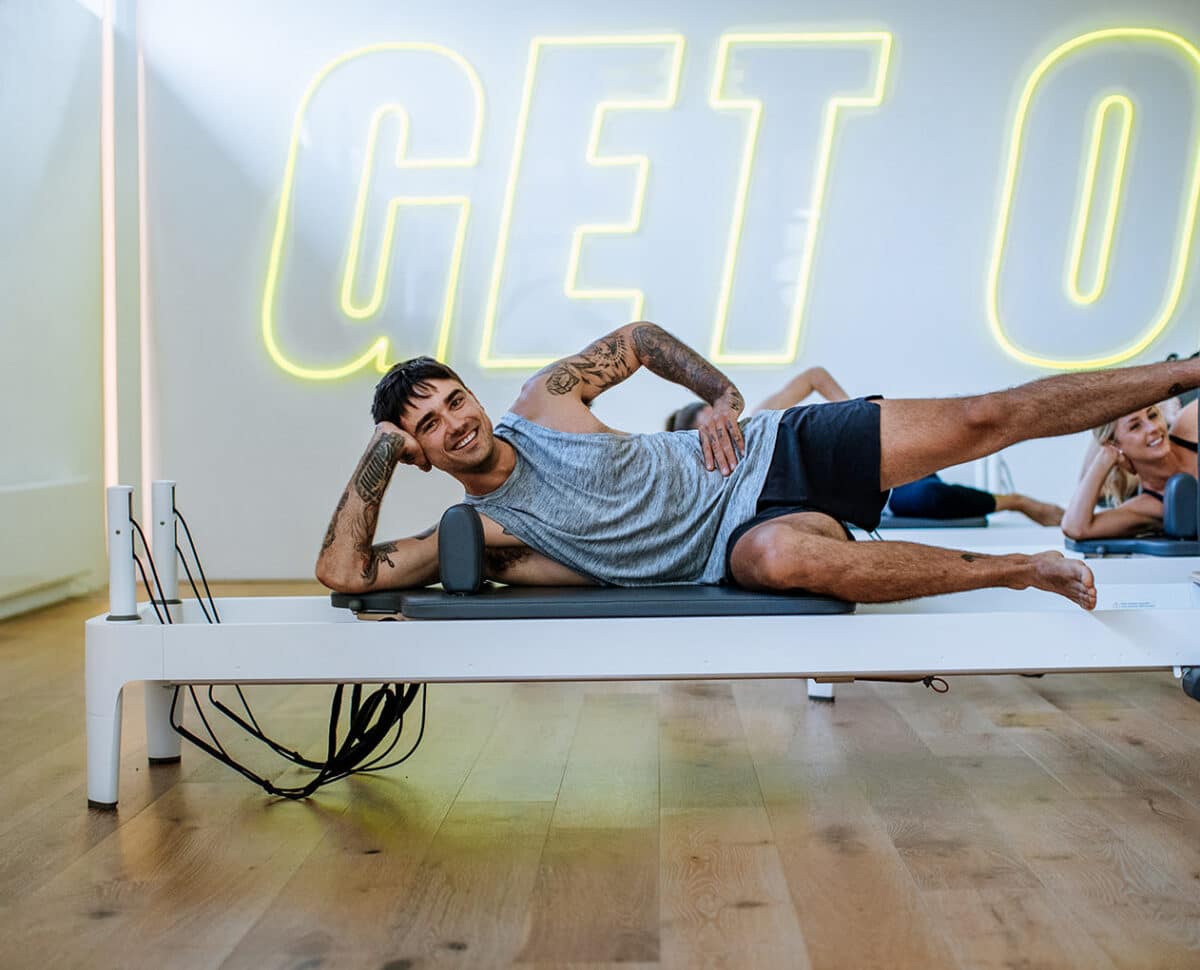
Pilates for men is absolutely worth considering if you want to build core strength, stability, mobility, balance and body awareness alongside your usual training. If you lift weights, play sport, run, cycle, surf or spend most of your day sitting at a desk, it can strengthen muscles and movement patterns that traditional strength training often misses.
It challenges your body in ways standard gym work doesn’t always address: controlled movement, coordination, posture and the ability to maintain good form while your muscles are under tension. That makes Pilates useful not just for getting stronger but for supporting recovery, reducing injury risk and improving how you move in sport and everyday life. And no, Pilates isn’t just for women. It’s a training method that can benefit anyone interested in a stronger, more mobile and better-connected body.
Whether you’re a complete beginner or an athlete looking to complement your current routine, here’s what you need to know about where Pilates came from, the benefits for men, how it differs from traditional strength training, the difference between Reformer and Mat classes, common exercises, what to wear, what to expect in your first class and how it can fit alongside gym workouts or sport.
Pilates Was Actually Invented by a Man
A fact that often gets overlooked: Pilates was developed by a man. Joseph Pilates created his method in the early 20th century, originally calling it Contrology. His approach focused on controlled movement, breathing, concentration, strength and physical rehabilitation. It was developed to help people improve their physical condition, including injured soldiers and dancers.
In other words, Pilates was never designed as a workout exclusively for women. Its foundations are rooted in strength, control, rehabilitation and conditioning, principles that are relevant to athletes and everyday movers alike. The association between Pilates and women largely developed later as the method became more popular in group fitness studios. But the exercises themselves haven’t changed their fundamental purpose: helping people move with greater control, stability and awareness.
Why Men Often Get More Out of Pilates Than They Expect
Many men arrive at Pilates with plenty of strength but less experience with controlled, stabilising movements.
You might be able to squat a heavy weight, run several kilometres or complete a demanding gym session, but that doesn’t necessarily mean every muscle involved in balance, posture and joint stability is working efficiently.
Pilates places a strong emphasis on the smaller stabilising muscles, the deep core muscles, controlled range of motion and proper alignment while moving. This can expose weaknesses or movement patterns that aren’t always obvious during more familiar forms of exercise.
For example, holding a plank isn’t necessarily difficult because you lack strength. It may become difficult because you’re being asked to maintain a precise position, control your breathing and keep your pelvis and spine stable without relying on momentum or external load.
The same applies to exercises such as the dead bug, single-leg work or controlled spinal movements. They require coordination between your core, hips, shoulders and breath — not simply the ability to produce force. That combination can enhance athletic performance and lead to better performance in sport and training.
Pilates Core Strength vs Traditional Ab Training
Traditional gym-based ab work often focuses on the muscles you can see, such as the rectus abdominis, while Pilates also trains the deeper core muscles involved in stabilising the trunk, including the transverse abdominis and multifidus.
The goal isn’t simply to create a stronger-looking midsection. It’s to build functional strength, improving how your core supports movement and helping you maintain control as your arms and legs move independently.
That can be useful when lifting, running, changing direction in sport or simply moving through everyday life.
Mobility That Complements Strength
Strength training is valuable, but repetitive training patterns, long periods of sitting, or sport-specific movements can leave certain areas feeling restricted and create tight muscles.
The hips, hamstrings, shoulders and upper back are common areas where people may benefit from more mobility work. Pilates incorporates controlled movement through these areas, helping open the hip flexors while building control through the range rather than treating flexibility as something separate from strength.
Instead of simply stretching and holding a position, you’re often asked to move through a range of motion while maintaining control. That combination of mobility and stability is one of the reasons Pilates can complement a gym or sports routine.
A Growing Interest in Pilates Among Men
More men are also beginning to recognise Pilates as a legitimate form of training and conditioning, with growing traction among male athletes and professional athletes as well. Upstate has previously been featured in the Herald Sun in coverage of men taking up Pilates, reflecting a broader shift in how the method is being approached.
Pilates doesn’t need to replace the gym, running or sport. For many people, it works best as another tool in their training routine, and can be a game changer for men looking to support the training they already do.
For more on why men are taking up Pilates and how it can complement athletic training, check out:
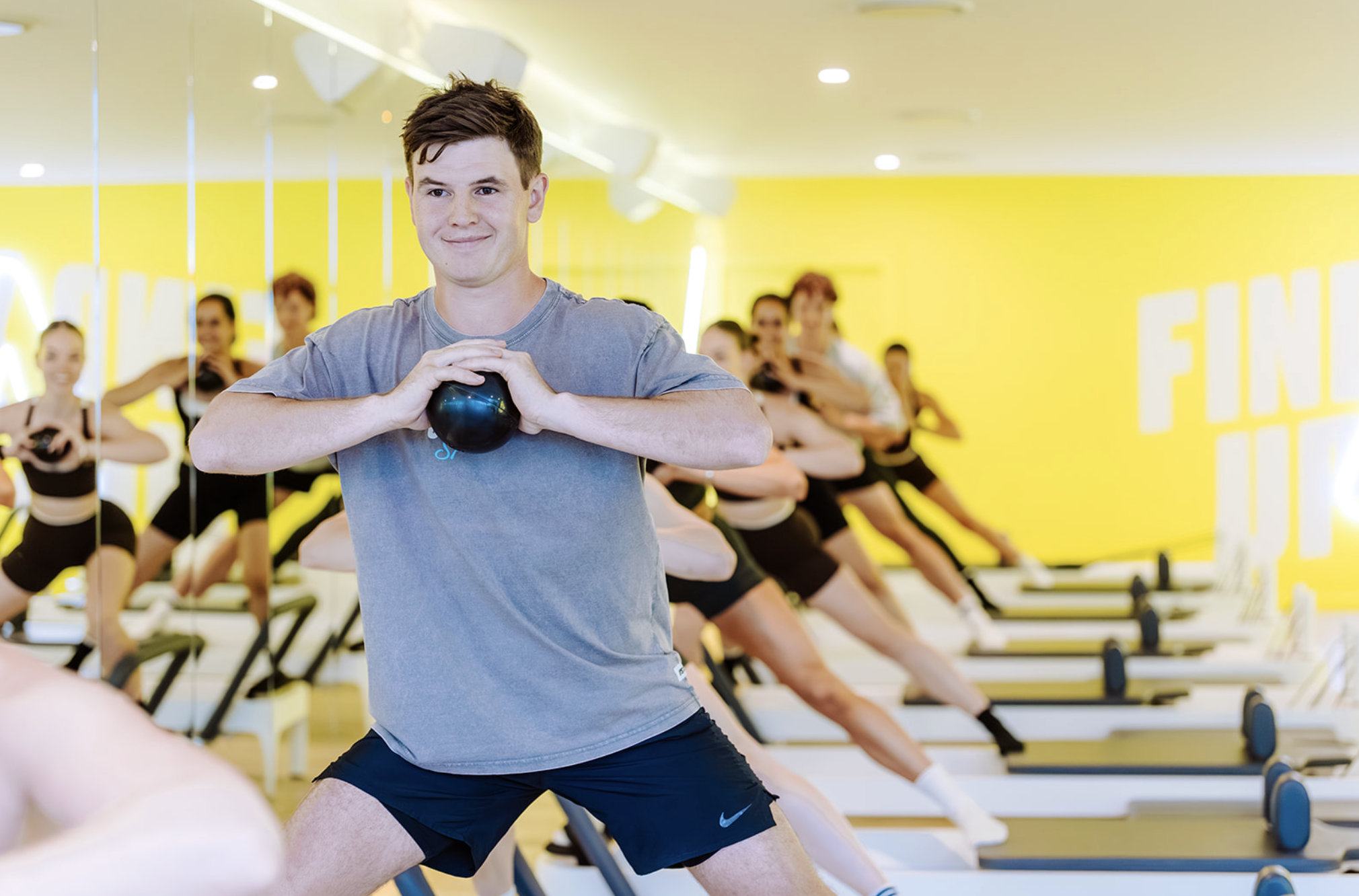
5 Benefits of Pilates for Men
Pilates isn’t a replacement for every type of training, and it doesn’t need to compete with the gym. Its value is often in the areas it develops alongside your existing workouts.
Here are five reasons men may find Pilates particularly useful.
1. Core Strength That Supports Movement
Pilates trains your core to do more than simply perform crunches or create visible definition.
Many exercises require you to stabilise your torso while your arms and legs move, teaching your body to maintain control under changing demands. This involves the deeper muscles around the abdomen, pelvis and spine, as well as coordination with the breath.
That type of strength can complement activities such as weightlifting, running and sport, where your ability to control your trunk can influence how efficiently you move. Stronger trunk control and shoulder stability can also translate to more power in lifting and sport.
What this means in practice: You may find that exercises involving balance, single-leg movements or maintaining a stable spine become easier to control over time.
2. Improved Mobility and Hip Flexibility
Tight hips and hamstrings are common complaints among people who sit for long periods, train regularly or participate in repetitive sports.
Pilates incorporates movements that work through hip extension, hamstring length, spinal articulation and thoracic rotation. Unlike passive stretching alone, many of these exercises ask you to build strength and control as you move through the range.
This can be particularly useful if your training is heavily focused on pushing, pulling or lifting but doesn’t include much controlled mobility work.
What this means in practice: You may notice that movements such as lunges, squats, rotation or reaching overhead feel more controlled and comfortable.
3. Support for Injury Prevention and Recovery
Pilates is often used as part of rehabilitation and conditioning programs because it is a low impact exercise that focuses on controlled movement, stability and gradually improving strength through a range of motion.
Physiotherapists and exercise professionals may incorporate Pilates-based exercises when helping people return to activity or address movement limitations. It’s also used by athletes as part of their broader conditioning and recovery routines.
That doesn’t mean Pilates can prevent every injury or replace individualised advice from a qualified health professional. But developing better movement control, strength and mobility can help prevent injuries, and its mindful approach stimulates the nervous system for recovery as part of a well-rounded training approach.
What this means in practice: Pilates can provide a lower-impact way to keep moving while developing skills that support your other training. If you’re recovering from an injury, always follow the advice of your treating professional.
4. Better Posture After Sitting All Day
If you spend hours at a desk, in a car or looking at a screen, you may be familiar with tight hips, rounded shoulders or stiffness through your neck and upper back.
Pilates encourages awareness of spinal alignment, pelvic position and shoulder placement. It also strengthens the muscles that help improve posture and improve alignment, including support through the posterior chain, rather than simply asking you to sit or stand up straight.
For people who spend much of the day sitting, this focus on movement and body awareness can be especially valuable.
What this means in practice: You may become more aware of how you sit, stand and move, while developing the strength and mobility needed to support more comfortable positions.
5. Active Recovery Between Training Sessions
Recovery doesn’t always have to mean doing nothing. For many people, gentle or controlled movement can be a useful way to stay active between more demanding workouts, and breath-led, mindful movement may also reduce stress and improve mental clarity.
A Pilates class can provide an opportunity to move through different ranges of motion, work on stability and focus on breathing without the same type of loading as a heavy gym session.
This same approach may help you recover faster between demanding workouts because the mindful approach in Pilates stimulates the nervous system for recovery.
Depending on the class and your individual needs, this may help you feel less stiff and more connected to your body between training days.
What this means in practice: A Pilates session can be a useful complement to your weekly routine when you want to move, focus on technique and work different muscle groups without adding another heavy lifting session.
For more information about the benefits of Pilates and how it compares with other forms of training, explore:
- Top 10 Reformer Pilates Benefits (Backed by Science)
- Pilates vs. Weight Lifting
- How Pilates Supports a Calm, Positive State of Mind
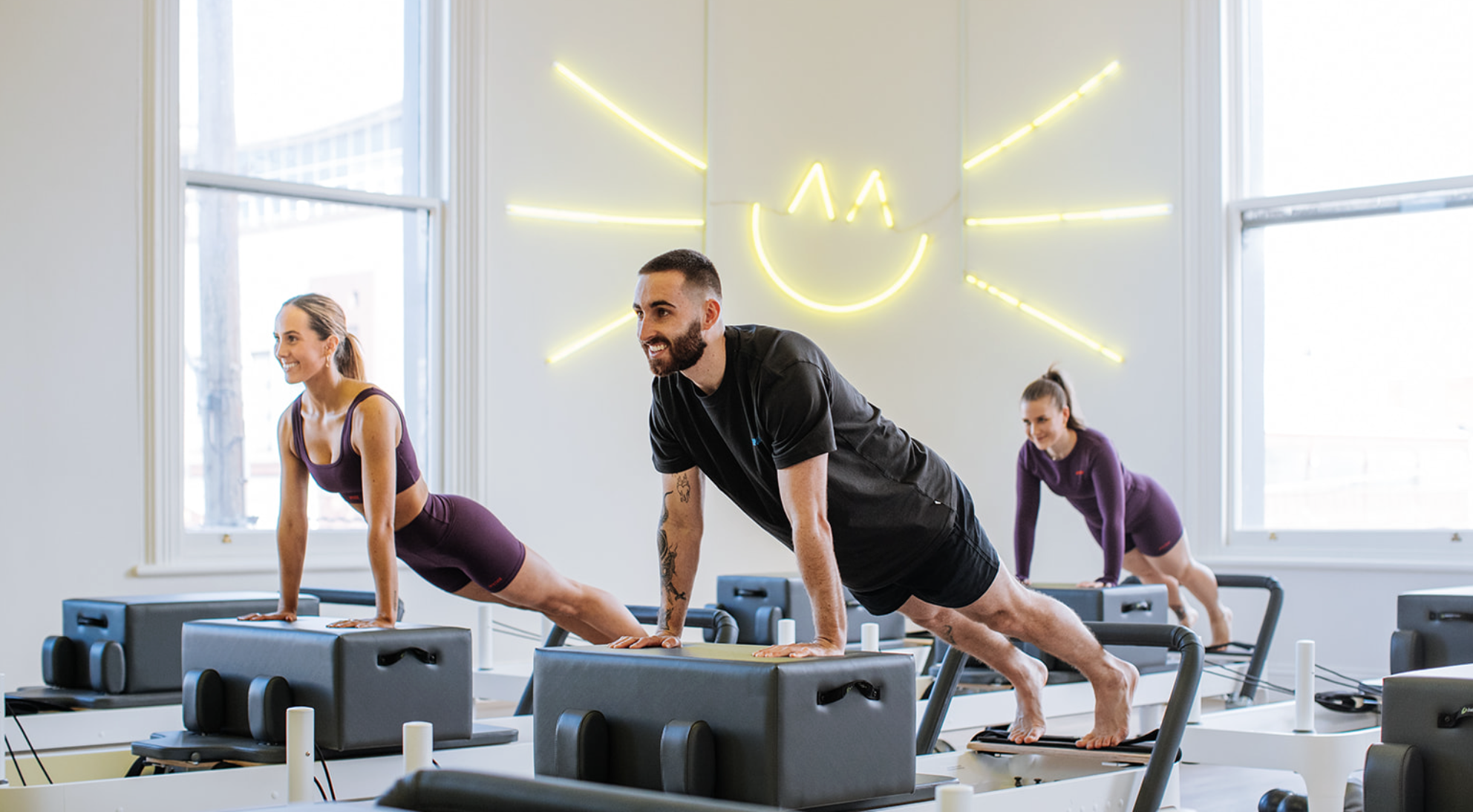
Reformer vs Mat Pilates: Which Is Better for Men Starting Out?
If you’re new to Pilates, one of the first questions you might have is whether to start with Reformer or Mat.
Both use the same fundamental principles of controlled movement, breathing, alignment and core engagement, but the experience is different.
Reformer Pilates
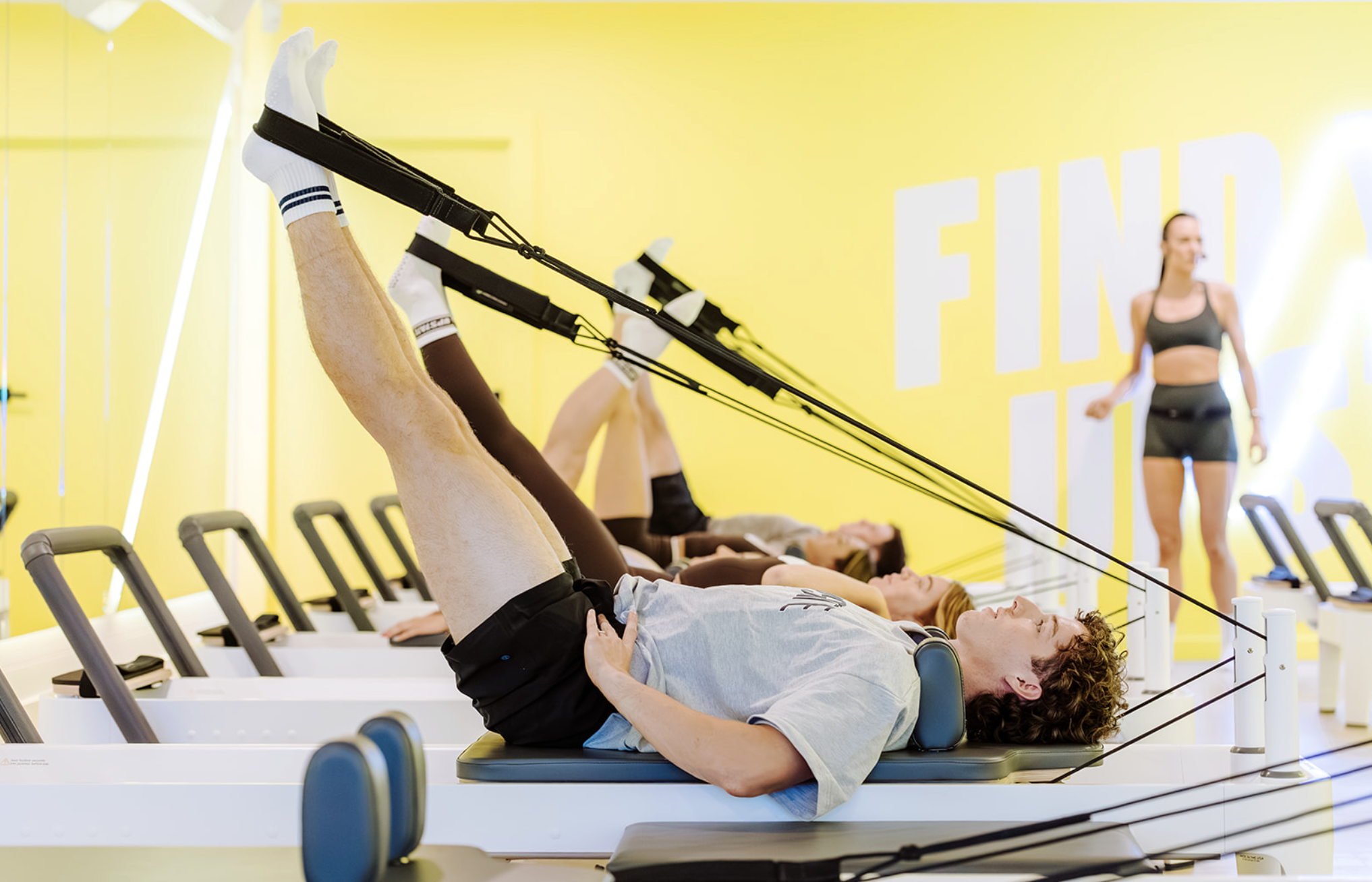
Reformer Pilates uses a specialised machine with springs, a sliding carriage, a footbar and straps. The springs provide resistance and can also assist certain movements, making the Reformer a versatile piece of equipment.
For beginners, the machine can make it easier to understand where your body should be positioned and how to control a movement. It also offers a variety of exercises that can challenge your strength, stability and mobility. For some beginners, Reformer can build strength faster than Mat Pilates because the machine adds adjustable resistance.
For someone coming from a gym background, the resistance and structured setup may feel familiar, while the controlled tempo and smaller stabilising movements provide a different kind of challenge, and Footwork builds lower-body strength without joint impact.
Mat Pilates
Mat Pilates is performed using your body weight, often with small props such as rings, balls or resistance bands.
It can look simple, but many mat exercises require significant core control, balance and coordination. Without the assistance or resistance of a Reformer, certain movements can feel surprisingly demanding.
Mat Pilates is also convenient because it requires minimal equipment and can be practised in many different settings.
Which One Should You Try?
There isn’t one option that is universally better. Reformer and Mat Pilates complement each other, and your preference may depend on your goals, current fitness levels, experience and the type of movement you enjoy.
If you’re completely new, Reformer can be a useful introduction to the principles and equipment, while Mat is a great way to develop bodyweight control and stability.
At Upstate, you can try both and see which style suits you.
For more information, read:
5 Pilates Exercises Men Should Know Before Their First Class
You don’t need to memorise a list of exercises before attending Pilates. Your instructor will guide you through everything. But understanding a few common movements can make the first class feel a little less unfamiliar.
Here are five exercises you may come across in a Pilates class.
1. The Hundred
The Hundred is a classic Pilates exercise involving a controlled abdominal position and rhythmic arm movements while maintaining steady breathing.
It challenges core endurance, coordination and the ability to maintain a stable position while breathing.
What men may find challenging: You might be able to hold the position, but coordinating the breathing and arm movement without losing control can be the real test. Avoid holding your breath or allowing momentum to take over.
2. Reformer Footwork
Footwork is one of the foundational Reformer exercises. Lying on the carriage, you press the platform away with your feet against the spring resistance before returning with control.
It works the legs while also asking you to maintain pelvic and spinal alignment.
What men may find challenging: The movement can look straightforward, but using too much force or moving too quickly can make it harder to maintain control. The goal is not simply to push as much weight as possible.
3. Long Stretch or Plank Variation
The Long Stretch is a Reformer exercise performed in a plank-like position, using the carriage to challenge your core, shoulders and upper body.
It requires you to maintain a strong, stable line while moving the carriage with control.
What men may find challenging: Strength isn’t always the issue. Maintaining alignment through the hips and shoulders while breathing steadily can be more demanding than expected. Avoid dropping through the lower back or gripping excessively through the shoulders.
4. Single Leg Stretch
The Single Leg Stretch is a mat-based exercise involving alternating leg movements while maintaining a controlled abdominal position.
It challenges core stability, coordination and the ability to keep the pelvis steady as the legs move.
What men may find challenging: Many people compensate by using momentum or allowing the lower back to lift away from the mat. Slowing the movement down and focusing on control is more important than how far or how quickly the legs move.
5. Swan or Spine Extension
Swan exercises focus on spinal extension and strengthening through the back of the body. Depending on the variation, they may be performed on a mat or using Pilates equipment.
They encourage movement through the upper back while building awareness of how the spine and shoulders work together.
What men may find challenging: It can be tempting to force the movement by lifting as high as possible. Pilates focuses on controlled range, so the goal is to move comfortably and avoid compressing or straining the lower back.
The key takeaway? Pilates isn’t about how much weight you can move. It’s about how well you can control your body while moving it.
What to Wear to a Men’s Pilates Class
You don’t need a completely new wardrobe to try Pilates. The same activewear you’d wear to most workouts will usually work well in most studios.
Here’s what to keep in mind:
- Fitted workout shorts or leggings: Choose something that allows you to move freely without excess fabric getting in the way.
- A fitted T-shirt or singlet: Comfortable activewear is ideal.
- Grip socks: Many studios require socks for Reformer classes for hygiene, traction, and stability.
- No shoes on the mat: Pilates is generally performed barefoot or in grip socks, depending on the class and studio guidelines.
The main thing is not to overthink it. Come in comfortable workout gear that lets you move.
For more tips, read What to Wear to Pilates Class.
What to Expect at Your First Men’s Pilates Class at Upstate
Walking into your first Pilates class can feel unfamiliar, especially if you’ve never used a Reformer before. The good news is that you don’t need any previous Pilates experience to get started.
Arrive a Little Early
Give yourself a few extra minutes to check in, get comfortable and let your instructor know it’s your first class. They’ll be able to explain the equipment, answer questions and help you get set up.
Get Familiar with the Reformer
If you’re taking Reformer Pilates, your instructor will introduce you to the main parts of the machine, including the springs, footbar, straps and carriage.
You’ll learn how to adjust the equipment and how it works throughout the class. There’s no expectation that you’ll know what everything does before you arrive.
Expect a 45-Minute Workout
Upstate Reformer classes run for 45 minutes and typically move through a range of exercises designed to challenge strength, stability, mobility and control.
You’ll usually begin with a warm-up, work through a series of exercises and finish with movements that help you cool down and reset.
It May Challenge Muscles You Don’t Usually Notice
You might feel the workout in your legs, glutes and core, but you may also notice your inner thighs, hip rotators, shoulders and smaller stabilising muscles working harder than expected.
That’s part of the difference between Pilates and more familiar gym-based movements. The focus is on control, alignment and precision, not simply moving the heaviest load.
You may also experience some mild muscle soreness after your first session, particularly in areas you haven’t trained in the same way before. If you experience pain or anything that feels unusual, speak with your instructor or a qualified health professional.
What About the Class Environment?
Yes, depending on the studio and session, there may be more women than men in the room. But Pilates is for everyone, and you don’t need to feel like you have to fit a particular mould to participate.
You also don’t need a particular background or experience level to begin your Pilates journey.
At Upstate, the focus is on movement, training and having a good experience. Everyone is concentrating on their own workout, their own technique and their own springs.
You don’t need to be flexible, coordinated or experienced to begin. You just need to show up and be willing to learn.
For more information about getting started, check out:
- 10 Things to Know Before Your First Pilates Class
- New to Upstate
- 10 Pilates Terms Every Beginner Should Know!
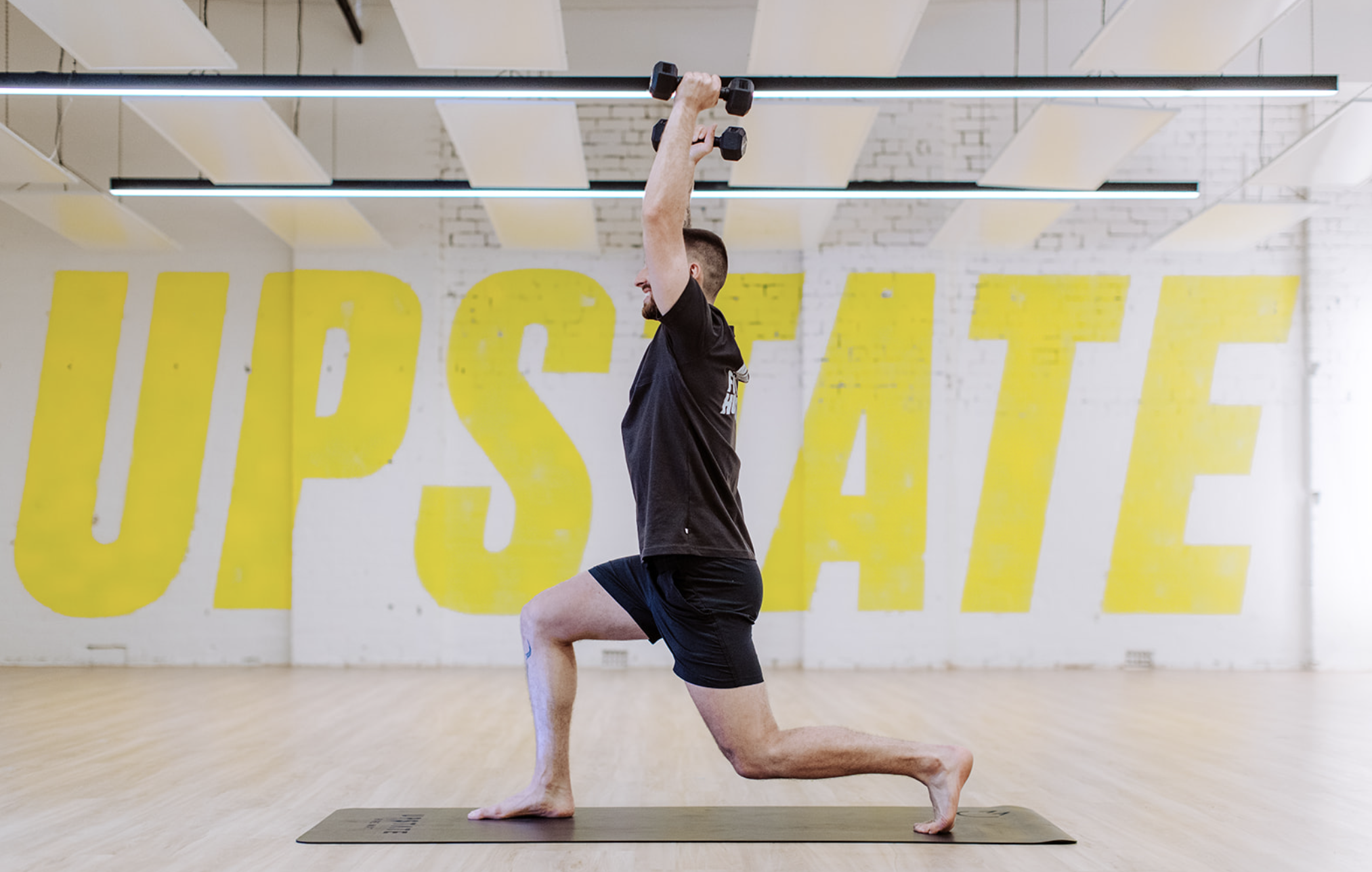
Try Your First Pilates Class at Upstate
If you’re looking for a way to complement your gym routine, support your sporting goals or simply move differently, Pilates is worth exploring.
At Upstate, you can try Reformer Pilates, Mat Pilates, Boxing and Yoga across our studios. That means you can build a routine around the types of movement you enjoy, whether you’re looking for strength, mobility, a sweat or a way to reset between training sessions. It can also complement an existing yoga practice, especially if you want more stability and control.
Our 30-day intro offer is $59 and gives you access to all class styles, including Reformer, Mat Pilates, Boxing and Yoga, across all locations.
If you’re already interested in boxing or want to pair Pilates with something more familiar, many Upstate locations also offer Boxing classes, with a range of pilates studios and class options across locations.
Ready to give it a go?
- Explore Upstate Studio Locations
- View Class Timetables
- View Pricing and Intro Offers
- Explore Boxing Classes at Upstate
FAQs
Is Pilates good for men?
Yes. Pilates can help develop core strength, stability, mobility, balance and body awareness. It can be particularly useful as a complement to gym training, running, sport or a sedentary lifestyle.
Is Pilates harder for men?
Not necessarily. Pilates can be challenging for anyone, especially when they’re unfamiliar with the controlled movements and stabilising muscles involved. If you’re used to lifting heavy weights, you may find the slower pace and precision surprisingly demanding.
Will Pilates make me less bulky or cause me to lose muscle?
Pilates does not automatically cause muscle loss or make you less muscular. It is a form of exercise that can complement strength training. If building muscle is your goal, resistance training, nutrition and overall programming remain important. Pilates can be included alongside those activities.
Should I do Pilates or the gym?
You don’t necessarily have to choose. The gym and Pilates train your body in different ways and can work well together. Weight training is valuable for building strength and muscle, while Pilates focuses heavily on controlled movement, stability, mobility and coordination.
What is the difference between Pilates and yoga for men?
Pilates generally places more emphasis on core strength, controlled movement, stability and muscular endurance. Yoga can place greater emphasis on flexibility, mobility, balance, breathing and mindfulness, depending on the style. Both can be useful, and the right choice depends on what you’re looking for.
How often should men do Pilates?
That depends on your goals, training schedule and experience. Starting with one or two classes per week can be a practical way to become familiar with the movements and see how Pilates fits alongside your existing routine. You can adjust your frequency as you become more comfortable.
What should men wear to Pilates?
Comfortable, fitted workout clothing is ideal. Shorts, leggings, a T-shirt or singlet are all suitable. Grip socks are recommended for Reformer classes, and Pilates is generally performed without shoes.
Is Reformer Pilates good for men with back pain?
Pilates-based exercises are sometimes used in rehabilitation and may help some people improve strength, mobility and movement control. However, back pain can have many causes, and Reformer Pilates isn’t suitable for every condition or stage of recovery.
If you have back pain, particularly if it’s persistent, severe or affecting your movement, speak with a qualified health professional before starting. Your instructor should also be informed so they can discuss appropriate modifications.
This version is ready to use as a longer SEO blog. I’d recommend adding a few genuine Upstate-specific details or a short quote from an instructor if you want to make it feel even more authoritative and less like a general Pilates explainer.